Musings on success from someone seeking (The War of Art review)
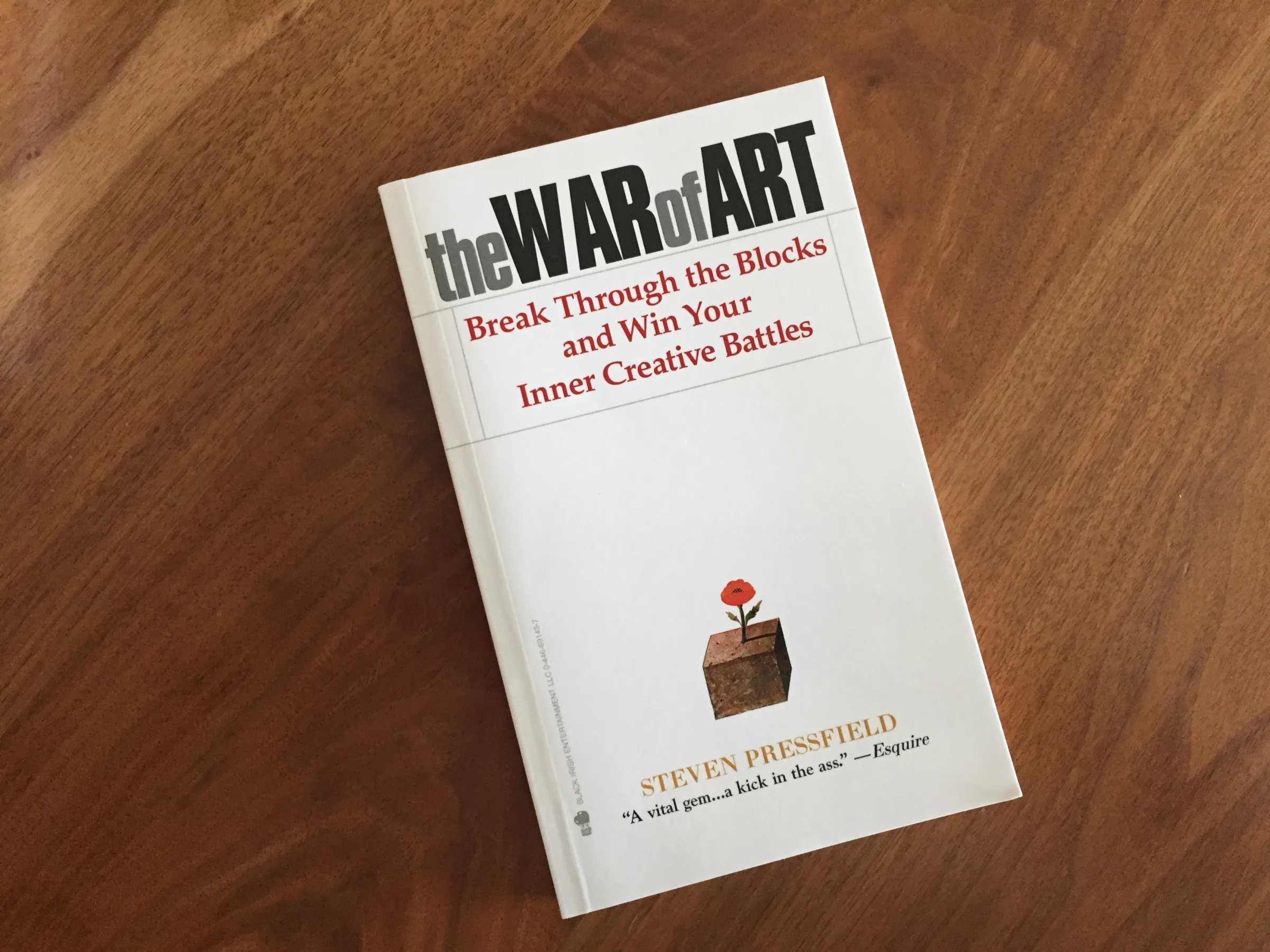
I just finished “The War of Art” by Steven Pressfield and I wanted to collect/formalize my thoughts about it and about achieving success generally. While there was a lot of weird spirituality in the book, I did come away feeling motivated to continue working away on my craft. It also reinforced some things that I’ve already believed. The main purpose in writing this post is to formalize my thoughts on what success means and how to attain it to hopefully motivate me. If it is helpful to you, then that is just the icing on the cake!
A synopsis of The War of Art
This book makes a strong/motivating core argument that I have summarized below:
- Anytime you try to pursue anything, you will encounter “Resistance.” This is a force/entity that attempts to prevent you from achieving your “work.”
- Your “work” is a unique calling you have. The book asserts that each person is meant to bring something into the world, e.g. writings, athletic achievements, software, charitable deeds, etc.
- “Resistance” uses both internal (fears, anxiety) and external (sickness, family issues, life stressors) attacks as ways to stop you from achieving your work.
- One’s job is to overcome resistance by showing up every day, getting to work, and mastering your craft.
- Importantly, one’s job is NOT to attempt to make a slam dunk. Your goal shouldn’t be to sit down and make the next Apple. Instead, your goal is to sit down and complete that project that eats at you. If you don’t have that (which I don’t currently) then you just keep working on whatever projects you can think of until you get it.
That last bullet point is the main reason I’m writing this blog post. Let’s dive into it a bit more.
Why success shouldn’t be your primary goal
I want to start this section off by saying that I don’t consider myself successful, so take these thoughts with a grain of salt. To me, success means a few things:
- Being known as an expert in a field.
- Having the freedom to tackle the problems that you want to tackle (e.g. be your own boss or work a job because you want to not because you need to).
- Financial security to support yourself and family.
I’ve been thinking about how to achieve success in those terms for a while. The easiest way to measure this is to evaluate some people I consider successful and want to emulate (Andrew Kelly, Mitchell Hashimoto, Jonathon Blow, Paul Sellers) to determine what I can learn. It seems to me that those examples aren’t as driven by “success” as they are driven by the craft/problem. Now don’t get me wrong, some of their decisions are probably made to pursue notoriety, freedom, and financial security, but my impression is that the craft/work is always the core.
This is opposed to the usual advice around startups where the focus is fast iteration towards product-market fit. Instead of looking for product-market fit1, I think you should look for those problems that you are passionate about it. This is especially true considering that getting product-market fit is a highly stochastic problem where many parameters have to align. Continuing to complete projects gives you more starting seeds when exploring the product-market fit space to improve your chances. So instead of optimizing for product-market fit, you should be optimizing for completing meaningful projects, and eventually you will hit the right starting seed. The best way to do this is to become a person that finds satisfaction from completing their “work” for the work’s sake as opposed to finding satisfaction through users.
I want to analyze Zig in a little bit because hearing its origin story solidified things for me. There are many programming languages out there, with new ones being created consistently (just check HN). To me, the success of Zig seems almost incidental to the creator’s passion for the project. If I remember correctly, Andrew Kelly wanted to make some kind of low latency audio software and didn’t like any of the languages available, so he wrote his own.
Wow!
Listening to interviews, my impression is that as soon as he had the idea for Zig, it became his mission to bring it to fruition regardless of mainstream adoption or popularity. The adoption and popularity did come, but it came because Zig is actually a great language with many good ideas. It didn’t come because of fast iteration towards product-market fit. I want to someday make something like Zig instead of one of the million YC funded AI wrapper companies that get funded and then shutter their doors for one reason or another2.
I had these thoughts milling around in my head, but they weren’t really an active core belief until I read the War of Art. The argument of the book around success is that the great work (which leads to success) comes from outside yourself. In his view, you can’t just sit down and write the hit, you have to put in the daily work until the hit comes to you. Sadly even when the great idea comes, you may not actually recognize that it is a great idea. It’s probably better to not realize it’s a great idea and work away at it for love of your profession regardless. We don’t have to subscribe to the book’s Neoplatonism regarding where ideas originate from and how they are given to us. Instead, the key realization for me boils down to two simple statements (one being a quote):
You have to be lucky to be successful
but also:
The harder I work, the luckier I get
-- Samuel Goldwyn
You just have to keep working until you make success inevitable and stop worrying about product-market fit!!
Finish your projects!
Finishing projects is hard, and the difficulty scales the closer you are to being done. But finishing your projects (even if they won’t be successful) is probably the most important thing you can do. I found the video below really puts the importance of this well:
So to put my money where my mouth is…
The book’s focus on being a “professional” helps here. At work, even if you don’t like the project you have to get it done. That’s the essence of being a pro. This mindset is probably something that would be useful to have in personal projects. My manager recently told me that the worst thing when managing a project is to spend eng time on something that doesn’t ship. I’ve definitely wasted a lot of my personal eng time on projects that have never seen the light of day and that should probably stop.
Future side projects are going to be treated more like projects at work. Do more upfront analysis of the project, architecting/speccing, and timeline planning prior to giving personal projects the green. Once a project gets the green, I plan to complete it regardless of how hard/boring it gets. Building the habit of completing projects and never stopping is my best guess at how to achieve success and seems to be supported by the War of Art.
Weird spirituality (my biggest qualm)
I do want to raise a fair warning that there is a lot of strange new age spirituality in this book. The core message is still useful as long as you are careful about taking in some of the other spiritual beliefs. This warning is particularly pointed towards fellow Orthodox Christians. You should definitely be using discernment if you choose to read this book.
One surprising spiritually beneficial thing that came out of this was the author’s mention of his “prayer rule” prior to beginning his work. He has this prayer grabbed from Homer used to invoke his “Muse.” This description shamed me as I generally forget to say a prayer before beginning my work. Moving forward I will be saying the Jordanville prayer before starting work in hopes that I will be able to accomplish the duties God has set before me. I’ve copied this prayer below if you would like to use it yourself:
O Lord Jesus Christ, Only-begotten Son of Thine unoriginate Father, Thou hast said with Thy most pure lips: For without Me, ye can do nothing. My Lord, O Lord, in faith having embraced Thy words, I fall down before Thy goodness; help me, a sinner, to complete through Thee Thyself this work which I am about to begin, in the name of the Father, and of the Son, and of the Holy Spirit. Amen.
Thanks for reading and remember to finish your projects!
A relevant quote from the book: “When the hack sits down to work, he doesn’t ask himself what’s in his own hear. He asks what the market is looking for.” Hacks might find wild monetary success, but I still think I rather would not be one. ↩︎
For some reason writing this article, I keep thinking about Delve. Delve is a company that uses AI to automate SOC2 compliance. There supposedly was an insider leak that revealed Delve was faking compliance reports and auditing. I can’t help but think that the founders wanted success at any cost. If they were focused on the craft, I doubt this situation would have happened. I’d like to avoid being like Delve, even though their founders are probably considered as successful in the sense that they are well known, have freedom that comes with being a founder, and probably good income. ↩︎